-
Free play toys/organization
What are some toys that you allow out all the time - for free play - and then toys that are put away and only taken out at specific times?
-
-
Mostly I have some of everything out but will add more or switch out items according to interest so if they are spending a lot of time in one area I add more to expand the play. The items that are controlled are things that have small pieces and I want to be sure who is using them and where and that all pieces get put back when done so there is no risk of a baby finding a piece.
-
-
Euphoric !

I too rotate out most toys. When I started I had a lot out, but quickly learned that that just isn't of any benefit to them...they would just take every single toy out of the buckets and throw! Talk about HUGE mess/missing pieces! So, now I have small buckets of stuff (organized by theme) I pull out 1 at a time throughout the day for example: Kitchen/food stuff, tools, blocks, bowling, floor puzzles, cars & tracks, trains & tunnels, sorting bins, blocks, musical instruments, puppets, farm, wooden puzzles, play dough stuff etc... I also only keep a limited selection of about 10 books that I rotate out daily.
Children are great imitators.
So give them something great to imitate.
~Anonymous~
-
-
That's the problem I have right now - everything is dumped and scattered everywhere!
Do you not keep anything easily accessible to the kids then dreamalittledream? Is everything put away and you pull it out at your discretion?
-
-
The bane of my existance! I'm constantly asking them to clean up the last game or toys before starting something new. They would have every inch of my floor covered with toys and not mind at all but it makes me crazy. I'm always cleaning up. Some people talk about having a book station and a block station and a dress up station. My little ones don't do stations - they are messy maniacs.
-
-
Euphoric !

This is the one wall of my playroom with the 'floor toys' - its an older photo and some of the bins the kids put back backwards but only one I could find without my crew 'in' the photo that I could crop to share ... organization wise my key is everything has a home and every home is labelled with a photo both on the shelf and on the bucket it belongs in - the labels slide out so I can change and rotate the toys as needed and just slide in the new photo of the new item and store the photos of the previous toys with them in their storage container for my closet.
So I do to not care how much they take out as long as it is being USED in their play and the floor does not become a tripping hazard of 'abandoned toys' than we do a two second tidy to get it 'safe again' and they restart their play. If a child is dumping and walking away just for the sake of 'dumping' they get sent right back to 'tidy up the tripping hazard' and reminded 'toys are for playing with not for dumping' ... if they are playing a game of dumping and putting it back than I let them 'play' that game though cause the baby likes to do this but when he crawls away if he has not 'tidied it up' he too gets sent back to tidy it up.
When playtime is over the playroom goes back together like one big gigantic puzzle and everyone helps to put it everything in its 'home' so that they can find it again another day.
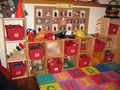
My outdoor shed is organized the same way - every bin is labelled on the shelf for easy to find for me and easy to tidy up at the day ... helps to teach the children to respect their environment and it also helps to reinforce that being 'organized' helps to create calm in ones self - cause when they cannot FIND something they need for play they get frustrated and grumpy about it and I always remind them 'well sorry you are frustrated but that's because you or your friends did not put it back in its HOME last time so you will have to look for it' and they hate wasting their playtime trying to find things ... so over time they grow to be a little OCD with the whole everything has a home thing and will even tell their PARENT if they try to put something away 'wrong' 
Children construct their own intelligence. The adult must provide activities and context, but most of all must be able to listen. Children need proof that adults believe in them. Their three great desires are to be listened to, to understand, and to demonstrate that they are exactly what we expect."
Loris Malaguzzi
-
-
Euphoric !
 Originally Posted by mlc1982

That's the problem I have right now - everything is dumped and scattered everywhere!
Do you not keep anything easily accessible to the kids then dreamalittledream? Is everything put away and you pull it out at your discretion?
I'm chuckling at "everything put away"....nope no playing here lol! I have, I would say about 40 toys that are out on a big shelf (these are the ones I rotate out weekly)...and yes, everything else I pull out 1 activity at a time. Makes for really fast tidy time & I really enjoy how they can take ne toy and use it for so many different things. I would love to be able to leave all the kitchen stuff out, for example, because they all love it so...but I would find the plastic food etc. everywhere (I have 2 busy little 1 year olds that wander off and hide things all the time . I also am really bad for changing the furniture around in our house...and it's not uncommon for the kids to wake up from nap to find the playroom completely changed around...it's like a whole new world. . I also am really bad for changing the furniture around in our house...and it's not uncommon for the kids to wake up from nap to find the playroom completely changed around...it's like a whole new world.
Children are great imitators.
So give them something great to imitate.
~Anonymous~
-
-
Originally Posted by Dreamalittledream
I'm chuckling at "everything put away"....nope no playing here lol! I have, I would say about 40 toys that are out on a big shelf (these are the ones I rotate out weekly)...and yes, everything else I pull out 1 activity at a time. Makes for really fast tidy time & I really enjoy how they can take ne toy and use it for so many different things. I would love to be able to leave all the kitchen stuff out, for example, because they all love it so...but I would find the plastic food etc. everywhere (I have 2 busy little 1 year olds that wander off and hide things all the time . I also am really bad for changing the furniture around in our house...and it's not uncommon for the kids to wake up from nap to find the playroom completely changed around...it's like a whole new world.
I'm with you in changing everything around. My guys never know what the playroom is going to look like lol. They get up from nap and look around like 'what happened' lol
-
-
Euphoric !
I am going to sound lazy here - but I never 'change' my entire playroom basically everything is set up the same 
I only change up things that are 'skills based' so once the group has mastered them they need something more challenging to scaffold their learning ... puzzles, books, offering blocks with smaller pieces and that sort of thing - everything else is pretty much a staple and always there. I also add or remove 'seasonal props' to the dramatic play and so forth.
In addition to the 'staples' in the playroom that are always there I also have 'invitations' that I bring out to set the stage for certain learning in the playroom for the 'table toys' area .... so the light table might come out, the marble bin, gemstones, the dark box and flashlights and so forth.
The SET UP of my room is ALWAYS the same ... the dramatic play items always in same area, the block corner in same area, the book nook quiet area and so forth never change.
I was at a workshop once and the gentleman who was the keynote speak made an awesome analogy that really struck home to me.... children are master chefs of their own play and learning - the playroom is their kitchen and some well chosen materials in that room are their ingredients ... and they can make 10,000 different recipes with those same ingredients and NEVER get bored....with children often 'less is more' in regards to creating deep and meaningful play! He said the more a toy 'does' for a child the 'less useful' it is for their play ... so even with 'food for dramatic play' if you have the option between a piece of plastic modeled 'pasta' and cutting up a ball of colored yarn and putting it in the bowl - choose the later because the later can become 100 things in play - the plastic modeled pasta will always be JUST PASTA
Than he spoke about 'toy rotation' and 'room rearrangement' ... things that are typically done weekly or biweekly in licensed care (the venue he was speaking to was mostly licensed caregivers) and said 'Now imagine you are a Master Chef and you arrive to work one morning and someone has REARRANGED your ENTIRE KITCHEN ON YOU ... how are you going to feel about cooking in that kitchen?'
Now some people are excited about change however MOST people even if they might be excited are also anxious/stressed at the same time ... this creates anxiety and stressed based behaviours in children ... you get that more pushing, fighting, crying and so forth as they learn to navigate that 'new kitchen' and just when they FINALLY get into the groove of playing chances are they arrive one day and the kitchen has been REARRANGED AGAIN ... and eventually what happens with children is they STOP trying to CREATE NEW RECIPES in their kitchen ... and than what you get is 'boredom' behaviour in the playroom because children stop getting 'attached' to any toys or play themes cause changes are in a week or two weeks its gone anyway.
I found when I made the change of thinking from this need to 'rotate' the toys or 'change the room around' constantly to prevent boredom an instead focused on ensuring that the choices in the room promoting open ended use that my crews imaginations flourished - they did more play with LESS materials and they play longer and BETTER with less need of help or support from me - and I ended up with more TIME for other more important things ... I get to spend my time observing, listening and well to be honest often multitasking other things so I do not have to do them after hours and so forth ... plus the added bonus very little 'stress' related behaviour in my program ... little to no arguing or crying and calmness generally prevails ... they can play often for over and hour block of time sometimes TWO without ANY help or intervention from me at all - peaceful purposeful engaged play with each other leading it - it is awesome! This has not only been my experience in my small 5 child group - but when I was using this approach in centre care as well with 8-12 children in the room
Children construct their own intelligence. The adult must provide activities and context, but most of all must be able to listen. Children need proof that adults believe in them. Their three great desires are to be listened to, to understand, and to demonstrate that they are exactly what we expect."
Loris Malaguzzi
-
The Following User Says Thank You to Inspired by Reggio For This Useful Post:
-
I have toys out that they can play with all the time if they choose, cars, work bench, kitchen with some kitchen food/pans but most is put up on shelves that I switch up.
For myself, I've found that when I had everything at the kids' level, they just brought everything out and then had a big mess and not want to play with anything getting a little overwhelmed.
During the summer months- most of our days are outside and the toys outside are left in the sandbox and clubhouse
-
Similar Threads
-
By Lee-Bee in forum Caring for children
Replies: 16
Last Post: 06-26-2015, 11:54 AM
-
By DaycareLady in forum The day-to-day as a daycare provider
Replies: 13
Last Post: 05-16-2013, 08:02 AM
-
By Littledragon in forum The day-to-day as a daycare provider
Replies: 7
Last Post: 03-26-2012, 06:33 PM
 Posting Permissions
- You may not post new threads
- You may not post replies
- You may not post attachments
- You may not edit your posts
Forum Rules
|











 Reply With Quote

